Dendrogram
Hierarchical clustering (Ward's method) of the injections or samples. If the biological differences in your study are larger than the technical noise, technical replicates should cluster together after filtering. That makes the dendrogram a good check on the CV threshold.
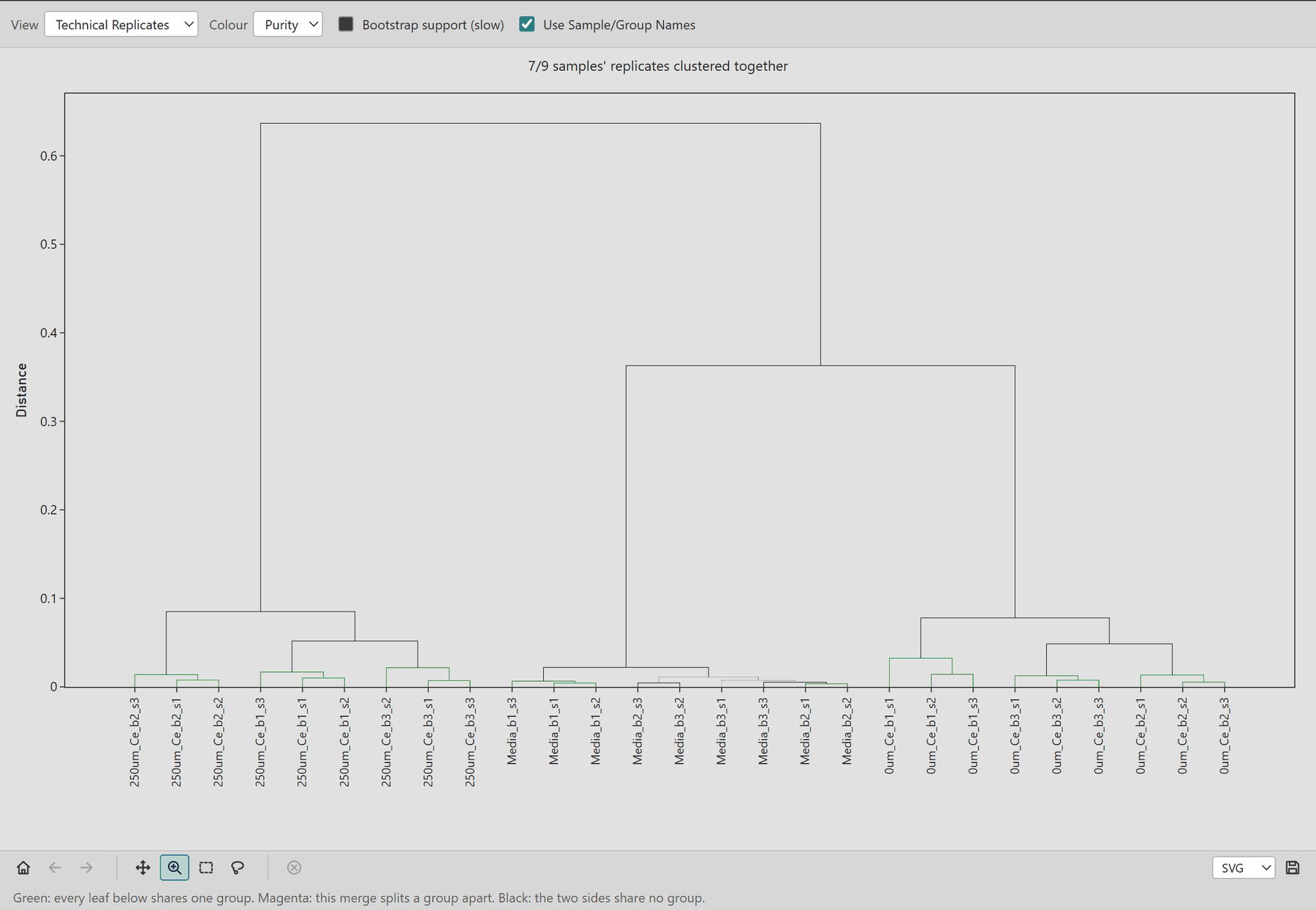
Controls
View
- Technical Replicates (default): one leaf per injection, to check whether each sample's injections agree.
- Biological Replicates: injections averaged first, one leaf per sample, to check whether samples group by treatment.
Colour
- Purity (default). A branch is green when every leaf below it belongs to the same sample (or, in the Biological Replicates view, the same group). A branch is magenta at the exact point where two samples' replicates are mixed, which is a real sign of poor clustering. Other branches stay black. The title counts how many samples are completely clustered, for example "7/9 samples' replicates clustered together".
- None: a plain dendrogram.
Magenta is used rather than red so that the colours stay distinct for readers with red-green colour blindness.
Bootstrap support (slow) resamples the data 1,000 times and labels each branch with two percentages: the approximately unbiased p-value (AU) and the bootstrap probability (BP). An AU above 95 is usually taken as strong support for that cluster. It takes noticeably longer on large datasets.
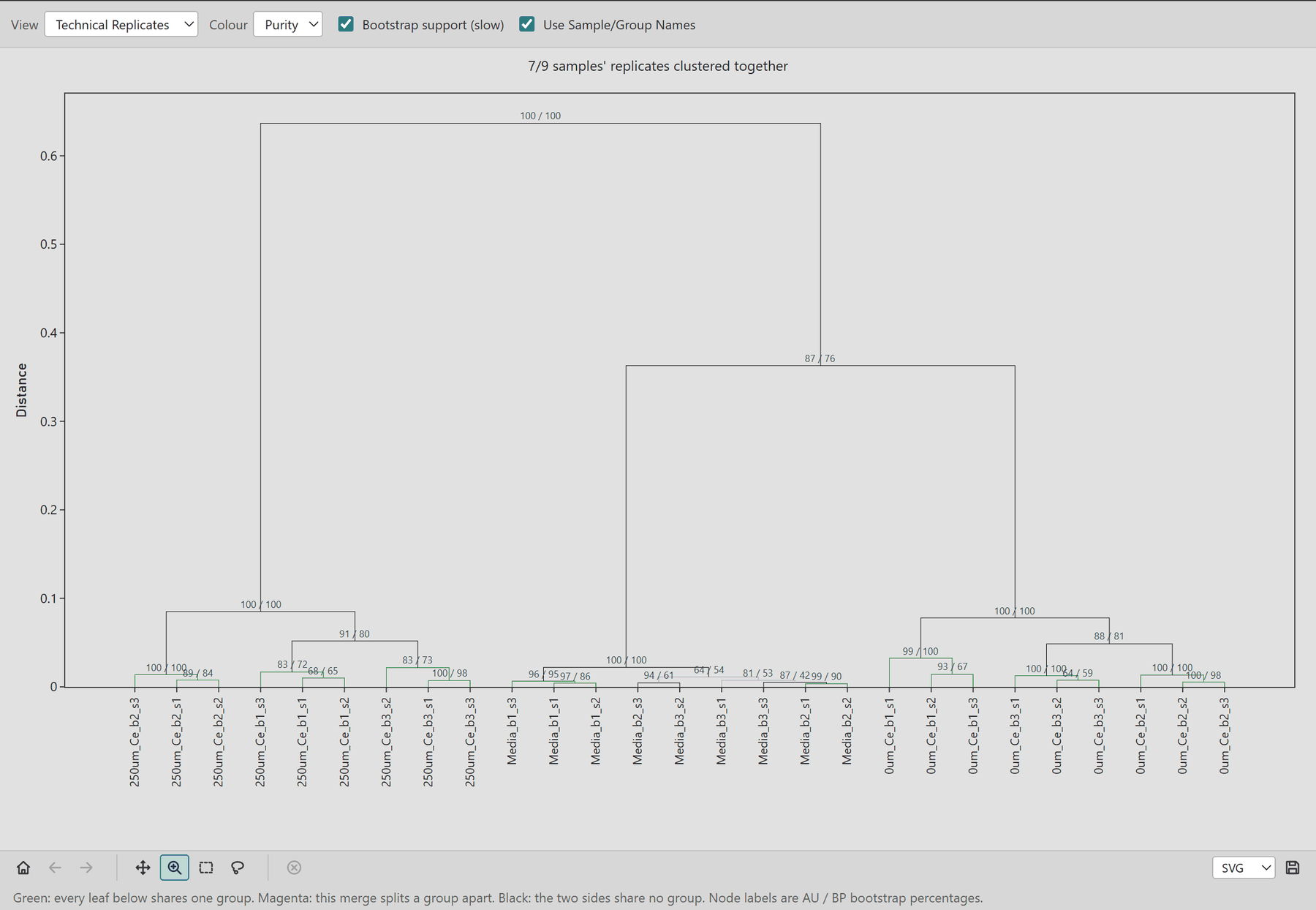
In the demo, the cerium groups cluster cleanly, while the media control's replicates overlap (the magenta branches).